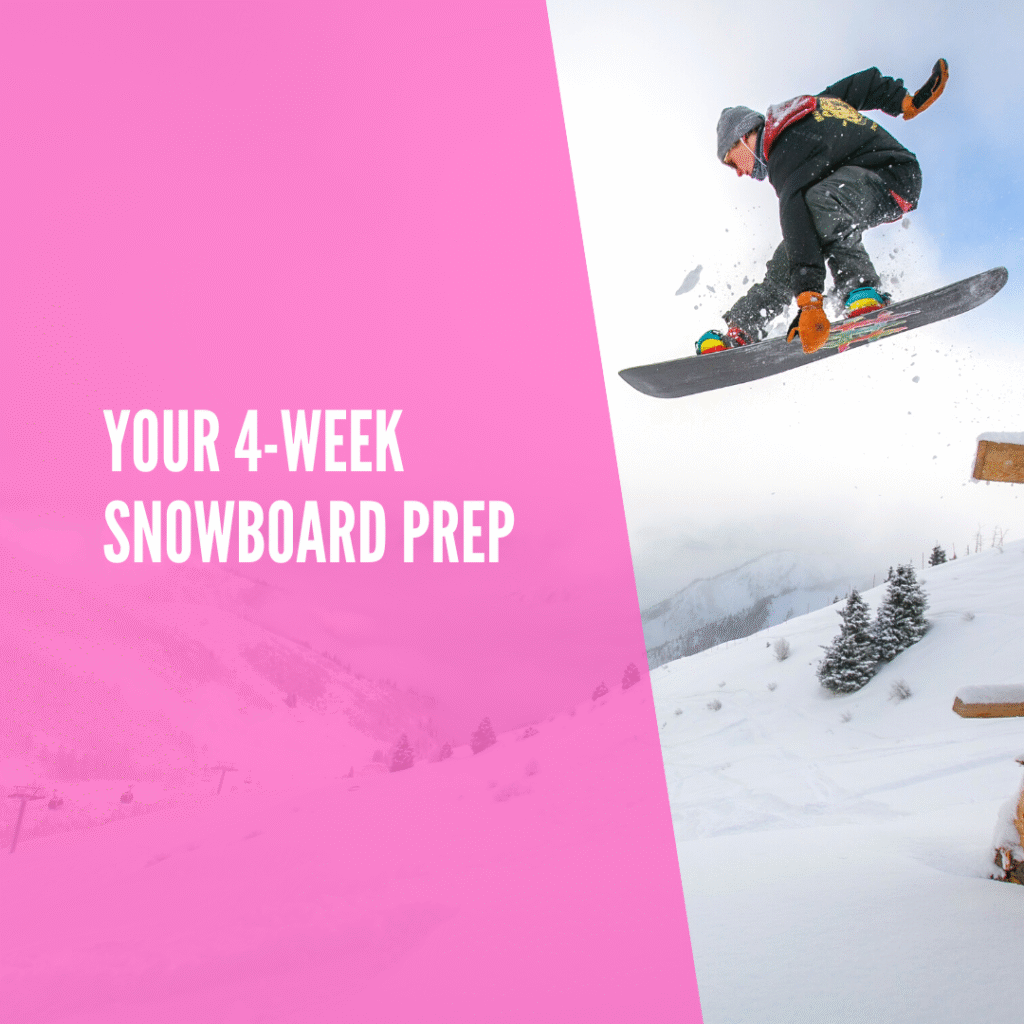
Snowboard season is here, and the call of the mountain is getting louder! We all want to progress, carve deeper, and ride longer without the brutal leg burn or the risk of injury. The secret to leveling up your riding this winter doesn’t start on the snow—it starts in the gym.
I’m passionate about snowboarding, and my journey began during high school in Switzerland (an incredible experience I was lucky enough to have!). That’s where I first strapped on a board and fell in love with the sport. Back then, my approach was simply to snowboard as much as possible.
Looking back, I realize how much focused strength training could have accelerated and enhanced my progress. It’s crucial not just for snowboarding, but for all sports and even everyday life. That’s why I created this 4-week workout program specifically designed to help you become a stronger, more stable snowboarder.
The Muscular “Teamwork” of Snowboarding
Snowboarding engages a variety of muscle groups, working together synergistically to maintain balance, control the board, and execute turns. Think of it as a low-impact sport with high-demand functional movement. To train effectively, you need to know which muscles are leading the charge.
Lower Body: The Engine and Shock Absorbers
The lower body is your primary motor, constantly absorbing impacts and generating the force needed for dynamic turns.
- Quadriceps: These muscles on the front of your thighs are crucial for maintaining the bent-knee stance, acting as springs to absorb shocks and initiate toe-side turns.
- Hamstrings: Located on the back of your thighs, the hamstrings work in conjunction with the quads to stabilize the knee joint and control explosive leg movements.
- Glutes: Your gluteal muscles (buttocks) play a vital role in maintaining balance, controlling hip movement, and generating power for deep turns and quick edge changes.
- Calves: These lower leg muscles are essential for subtle edge control and fine adjustments in balance, especially on heel-side edges.
Core: The Anchor of Stability
Your core is the bridge between your upper and lower body. Every turn, every landing, and every shift in weight originates here.
- Abdominals: Your core muscles—including the rectus abdominis, obliques, and transverse abdominis—are essential for maintaining balance, stability, and controlling your body’s movements while riding, particularly when hitting bumps or linking turns quickly.
- Lower Back: The muscles in your lower back help support your spine and contribute to the overall stability and balance needed to stay upright on uneven terrain.
Other Important Muscles
- Ankles and Feet: These small but mighty muscles play a crucial role in making subtle adjustments to maintain balance and precisely control the board’s edges.
- Upper Body: Used primarily for balance and stability. Your arms and shoulders shift to counteract the board’s movements, especially during spins and quick adjustments.
Why It’s “Teamwork”
Snowboarding isn’t about isolating one muscle—it’s about functional movement. Your training needs to reflect how these muscle groups work together to:
- Maintain Balance: Constantly adjusting your weight and position to stay upright and centered.
- Control Edges: Shifting your weight using your hips and core to engage the edges of the board for turning and speed control.
- Absorb Impacts: Bending your knees and using your muscle strength to cushion bumps and absorb the landing shock from jumps.
- Generate Power: Using your legs and core to initiate and complete sharp, aggressive turns.
The 4-Week Training Strategy
Our main focus will be on the lower body and core, since these are the primary drivers of turning and stability. We will then incorporate advanced elements to mimic the dynamic demands of the mountain:
1. Build the Foundation (Lower Body Power)
Focus on compound movements to build overall leg strength.
2. Sharpen the Core (Stability and Control)
Increase core strength for better rotational control during turns.
3. Develop Balance (Unilateral Work)
To further develop balance and stability, we’ll include unilateral (one-legged) exercises like Single-Leg Romanian Deadlifts (RDLs). Snowboarding is a unilateral sport—you are always shifting weight from edge to edge—so training one leg at a time is crucial.
4. Improve Explosiveness (Functional Power)
Finally, we’ll add functional, plyometric exercises such as Jump Squats or Box Jumps to improve your ability to execute jumps, absorb impacts, and recover quickly from minor imbalances on the slopes.
This 4-week commitment will pay dividends the moment you strap in. No more burning quads after the first run, just solid, confident riding from first chair to last call.
The program below is one example for you!
| Sunday | Monday | Tuesday | Wednesday | Thursday | Friday | Saturday |
| Squats Single leg RDL Split squats Glutes bridge Jump squats Calf raises | Deadlift Chest press Lat pulldown Face pull Bicycle crunch Plank leg raise | Rest or cardio & abs if possible | Rest or cardio & abs if possible | Squats Single leg RDL Split squats Glutes bridge Jump squats Calf raises | Deadlift Chest press Lat pulldown Face pull Bicycle crunch Plank leg raise | Rest or cardio & abs if possible |
| Rest or cardio & abs if possible | Deadlift Chest press Lat pulldown Face pull Bicycle crunch Plank leg raise | Squats Single leg RDL Split squats Glutes bridge Jump squats Calf raises | Rest or cardio & abs if possible | Rest or cardio & abs if possible | Deadlift Chest press Lat pulldown Face pull Bicycle crunch Plank leg raise | Squats Single leg RDL Split squats Glutes bridge Jump squats Calf raises |
| Rest or cardio & abs if possible | Rest or cardio & abs if possible | Deadlift Arnold press Chest fly Pullover Side plank pullover Plank leg raise | Squats Bulgarian split squat Lateral squat Reverse lunge Split squat jump Single leg glutes bridge | Rest or cardio & abs if possible | Rest or cardio & abs if possible | Deadlift Arnold press Chest fly Pullover Side plank pullover Plank leg raise |
| Squats Bulgarian split squat Lateral squat Reverse lunge Split squat jump Single leg glutes bridge | Rest or cardio & abs if possible | Rest or cardio & abs if possible | Deadlift Arnold press Chest fly Pullover Side plank pullover Plank leg raise | Squats Bulgarian split squat Lateral squat Reverse lunge Split squat jump Single leg glutes bridge | Rest or cardio & abs if possible | Rest or cardio & abs if possible |
Let’s start your workout!